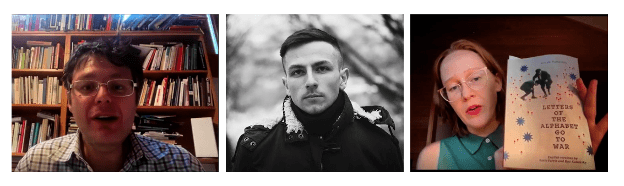
This special evening began not with a pair, but, ironically, a triptych. On March 18th, audience members from the Detroit Mercy community and beyond gathered to witness a merging of three spirits: Katie Farris and Ilya Kaminsky, poets and partners, standing as harbingers for the voice of Lesyk Panasiuk. Kaminsky is the acclaimed author of Deaf Republic and Dancing in Odessa, a poet whose work has been translated into over twenty languages and recognized with a Guggenheim Fellowship and the Whiting Award. Farris is an award-winning poet and translator, celebrated for her first full-length collection, Standing in the Forest of Being Alive, which was named a Best Book of 2023 by Publishers Weekly and shortlisted for the T.S. Eliot Prize.
We began our gathering framed by the words of Detroit Mercy’s Poet-in-Residence, Stacy Gnall, and her invitation to shed our steel beam definition of a translation. To prepare ourselves, we were urged to see the act of translation as an act of love—as American poet Richard Howard once described translation, “an exchange of mental fluids,” or in Jane Hirshfield’s words, “a heady, erotic surrender, to translate is to love.” To translate is to step into the skin of another and breathe.
Geography of the Displaced, the Tortured
In order to help us grasp, to feel, Ilya Kaminsky opened the portal first to Eastern Europe, into a landscape where the alphabet is a soldier drafted into service. He spoke to us, explaining that the war in Eastern Europe is a war against the humanities. In the cold logic of conflict, the scientist may flee to the laboratories of Paris, yet the museum worker, the teacher, and the poet remain in the crosshairs of Odessa, Kaminsky’s hometown. In Odessa, Kaminsky narrates, those who stay, stay to guard the culture, and in staying, they are “bombed, and bombed, and bombed.”
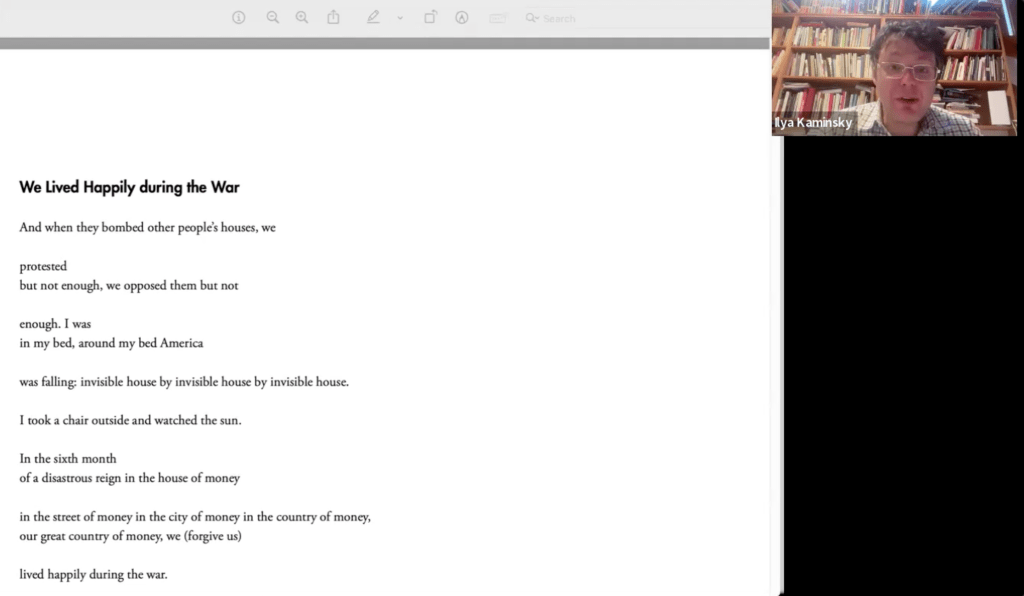
Kaminsky speaks of the refugees’ wait, the long weeks of seeking shelter, while children sit in the dark of bomb bunkers. In these cramped spaces, the thousand-page novel is too heavy a burden. This is why the soul demands the poem. Kaminsky says profoundly, “Poetry articulates the human nature in crisis.” Poetry—these brief, sharp articulations of human nature—can be memorized, recited over and over, and carried like a shiny stone in a threadbare pocket. It is the only currency left when the bank of normal life has been demolished.
Alphabet Massacred, Mutilated
While not physically present with us, it was the work of Lesyk Panasiuk that Kaminsky directed our focus back to. Panasiuk is a poet who came of age within the machinery of war. As a leading figure of the younger generation of Ukrainian poets, Panasiuk is a Smoloskyp Literary Prize winner, who reimagines the visual and linguistic boundaries of poetry in crisis. Panasiuk was a child when the war started and, while in his 20s now, his work (especially the poems in Letters of the Alphabet Go to War) are, in Kaminsky’s words, both “tragic but also very light and lyrical.”
Kaminsky posed the question: What happens to words, to poetry and to literature, in times of crisis? Kaminsky’s shared that, when asked, Panasiuk claimed that after the war he no longer believed in the metaphor. But upon further examination, Kaminsky noted that his work is actually full of metaphor. I cannot help but feel moved upon hearing this; even when we denounce poetry and its companions, it is embedded within our very beings.

When Katie Farris read from Letters of the Alphabet Go to War, the air shifted; how could it not? Farris first read “A Shoe Full of Water: A Diary of Return,” and the line “I no longer fear my own mutilation” haunted me. There is a daunting lightness to Panasiuk’s tragedy, a lyrical innocence that makes the horror of war sharper. The lines from “Little Palm” revealed a psyche where “Childhood is falling into snow,” falling, falling. When Farris read the poem from which the book’s title comes, “In the Hospital Rooms of My Country,” we saw how the Ukrainian language is ambushed. When the letters of the alphabet go to war, Panasiuk says, the letter “i loses its head.” It is a graphic image. In the hospital, letters are overcrowded. The apostrophe has no place to sit. Letters of the Alphabet Go to War is a stunning bilingual testament to the “etymology of torture,” and Kaminsky and Farris’s love is palpable throughout their translations of Panasiuk’s words.
A Body on the Stage, its Performance
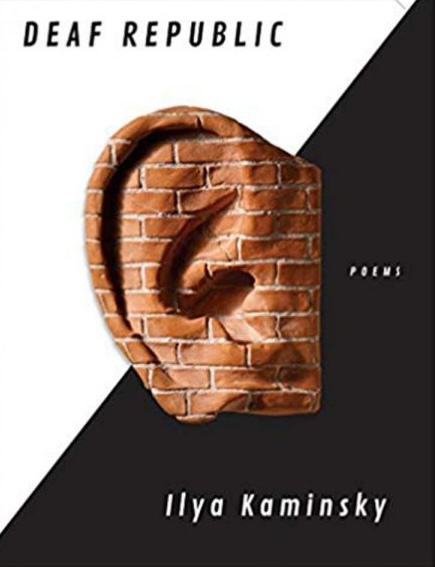
The evening moved quickly from the collective trauma of a nation to the singular trauma of the flesh. When Kaminsky reads, his voice emanates a song of fervor, “an incantatory performance,” as described fondly by Farris. When asked about his personal voice, Kaminsky himself cheekily said that it is designed to trap the wandering attention of the modern poet’s mind. Kaminsky read us poems from his second book, Deaf Republic. In “Gunshot,” he compares the country to a stage, and the soldiers’ march a spectacle. Many of his poems reflect the atrocities of war, but the one he ended his reading with was of love. The poem “Before the War, We Made a Child,” shows how love can live on in war, the line “whose freckles / arouse the neighbors” so intimate.
Farris then took ahold of our hands, reading from Standing in the Forest of Being Alive, a collection born in the shadow of a 2020 breast cancer diagnosis. Farris, using a similar metaphor as Kaminsky, writes that, on the morning of her port surgery, the operating room was a theater, and cancer was a stage play with a cruel progression. Her poems themselves are palimpsests, vellum made of animal skin that has been washed and rewritten, yet retaining the ghosts of what was erased. Within her work, she shocked me by drawing a startling parallel between the harboring of an unborn child and the harboring of a tumor, both “rapidly dividing cells held close to the heart.”
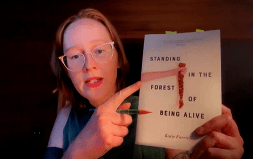
As she navigated the burning world through the lens of the “God of Radiation,” Farris recounted the impossible choice presented by her oncologist: uncertain death or certain damage. To choose life was to choose the fire of nerve damage, to choose the brachial plexus on fire. In her voice, we understood that poetry does not serve as a literary device. It is the craft of survival during a storm.
Skin the Lamb, Place it Anew
As the night drew to a close, the conversation turned to the audience. One participant asked about the mechanics of the soul’s exchange and the artist’s view on translation. Translation, Kaminsky noted, is the act of reading “taken to its most extreme intimacy.” It is the search for the secret pulse of the original poet.
When answering to the mechanics of writing, Farris offered a visceral metaphor for this process. She spoke of a mother lamb mourning her dead offspring. To save a new, orphaned lamb, one must skin the dead one and drape its hide over the living so the mother will accept it. She described that sometimes we cannot fit into the poem’s skin. Sometimes the translation must be an “homage” rather than a mirror.
In the end, we were left with the domestic image of two poets who have spent twenty three years reading to one another, exchanging mental fluids if you will. Their love is the foundation upon which their translations are built. Whether facing the crisis of a brutal medical diagnosis or the crisis of a falling city and the burn of war, they hold tight to the word. Ilya Kaminsky and Katie Farris reminded us that when the world burns, we do not write poetry to decorate the flames; we etch the words on our souls to find the way out.

Tasnim Uddin is a 5-year Physician Assistant student at the University of Detroit Mercy. Her academic and personal passions exist at the crossroads of medicine and the humanities. She hopes to balance a career in healthcare with a devotion to literature and the written word. When she is away from her studies, she finds her greatest inspiration in the company of her wonderful family.
 Between the Pages
Leave a comment