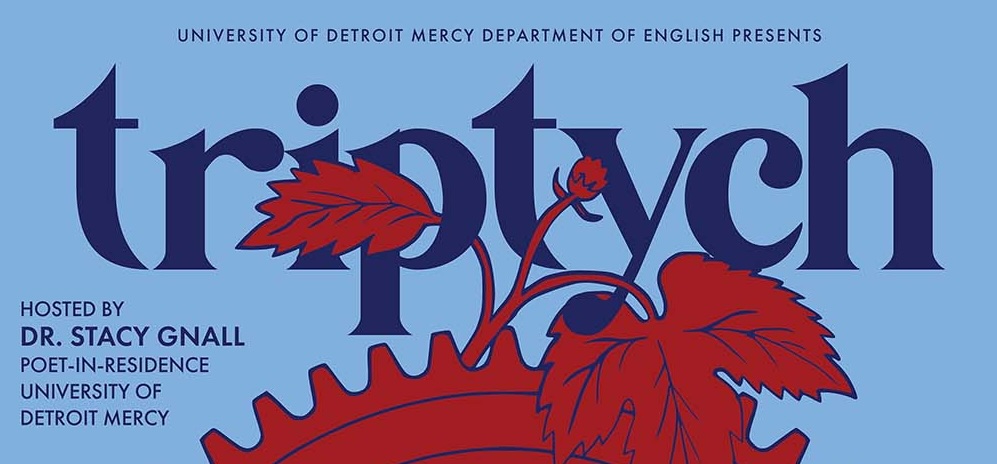
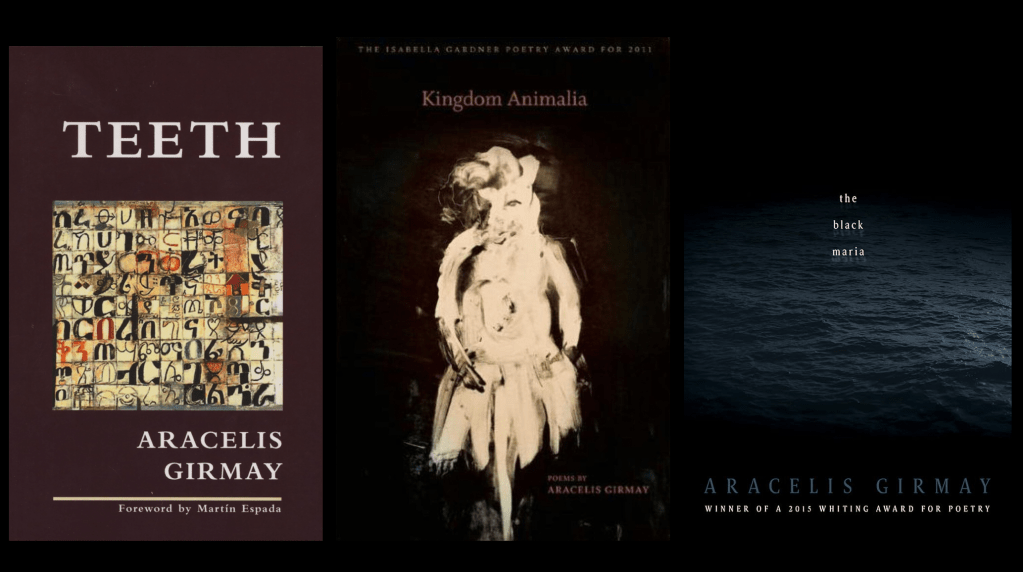
There are times—usually unbelievably hectic or stressful times—when life invites you to breathe. Requires it of you. The recent Triptych event featuring poet and Stanford professor Aracelis Girmay was exactly this breath for me. This reading, held via Zoom as part of the University of Detroit Mercy’s Triptych visiting author series, was the third and final reading of the 2025 season. Dr. Stacy Gnall, UDM’s poet-in-residence, began by introducing Girmay, saying that she is an “important and essential poet for our present moment, in all of its many fears and confusions.” This statement was cemented by the subsequent reading and Q&A session. Gnall predicted the audience’s time with Girmay perfectly by closing her introduction with the last lines of Girmay’s poetry collection, the black maria (2016):
Let me tie
the breath that I borrow to
the breath that you borrow,
let them meet through the green
that is you and that is me,
and knowing what we know now
of history and of love
let us name every air between strangers: reunion.

Showing true heart and humility, Girmay opened her reading with a poem by someone other than herself. Here, she paid tribute to the late Palestinan poet Hiba Abu Nada (killed tragically in her home on October 20th 2023) by sharing Abu Nada’s poem entitled “Not Just Passing.” The pieces of her own that she shared proved Girmay to be a poet not bound by genre. She is also unapologetically personal, tender, and self-exposed with grace. And, through her writing, she invites us into a pool of empathy for all of humanity.

As an incredibly organic thinker and speaker, Girmay recalled between poems how she believes in the importance of writing and expression, saying “How critical it is that we speak in our languages—the idiosyncratic, specific registers and ways we contribute and participate.” Because of this commitment to her own authentic voice, her poems are like portals or windows into both the everyday and the extraordinary in life. Her poetry is honest and raw yet refined, allowing what is heavy to be lifted with ease. She puts life and death into conversation—not as opposing voices, but as mediums to be mixed and used by all as we live in community with one another. Her words beautifully celebrate community and communal uplift, which is a skill that she was surely born with. But I hope that we, as budding authors, may glean some of it from her.
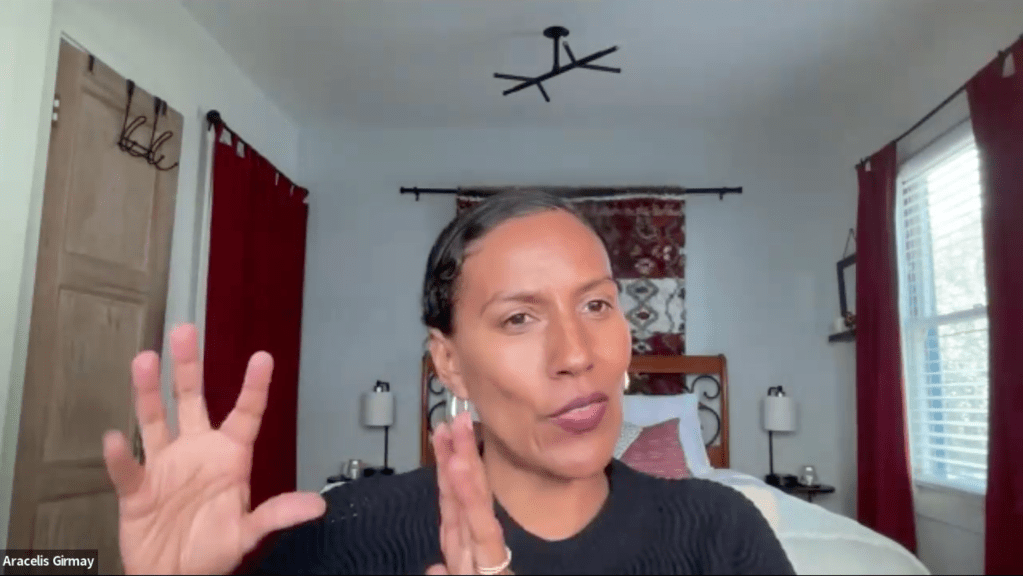
During the Q&A conversation, Dr. Stephen Pasqualina (of the UDM English department) pointed out Girmay’s ways of asserting contradictions and inversions that get us closer to a sense of wholeness, and asked how she inhabits language in such a way that it is invested in transcending the delimitations of the word. With great thoughtfulness, Girmay responded by pointing to the idea that we are all visiting this world—ownership of the world is absurd—and that this knowledge is in her marrow. She pointed to her many “back home” locations over her (and her family’s) lifetime as the founding of her global orientation. She recognizes the transcendent through knowing that we are all related, that “the atoms are here and moving through us.”
Girmay fielded another question, this time from student Ashlee Jones, who asked how the poet became so good at public speaking. To this, Girmay acknowledged her past experiences with nerves, and then encouraged in triplicate to “practice, practice, practice” and to attend readings in order to become better at reading. Girmay also advised leaning into those people who are generous in their support of us, as well as into our own inner voice’s prodding that “I have something, and I want to share it.”
In response to a question about revision, Girmay shared that “many, many, many, many, MANY drafts” are usually formed—at times, as many as 15-20—and that these drafts sometimes come rapid fire and sometimes over the span of years. When asked by Dr. Gnall if there was a pattern between which of her poems take more time and which come faster, Girmay responded that her work is slowed down when there’s “something, intellectually, I have the idea for, but the language hasn’t met the idea yet.”
Toward the end of the Q&A, Girmay returned to the idea of bringing to the world one’s idiosyncratic ways of reading and of inhabiting a room. She said: “I feel so amazed that I get to think with other people about poems. Part of that is because, in more cases, we are coming together with the desire to hear each other [and to] listen to possible readings or interpretations of text or word. That’s the agreement—to strain towards each other and think rigorously together.”
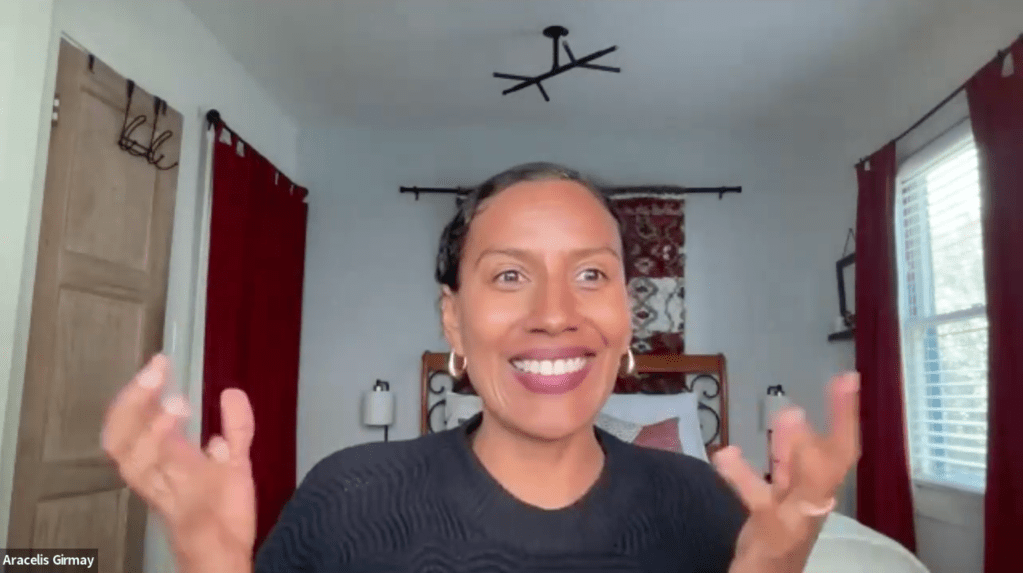
Girmay concluded the evening’s event with the following statements, which should be on every writer’s (or every person’s) wall:
“You make world when you come with what you have.”
and
“We make each other more possible.”
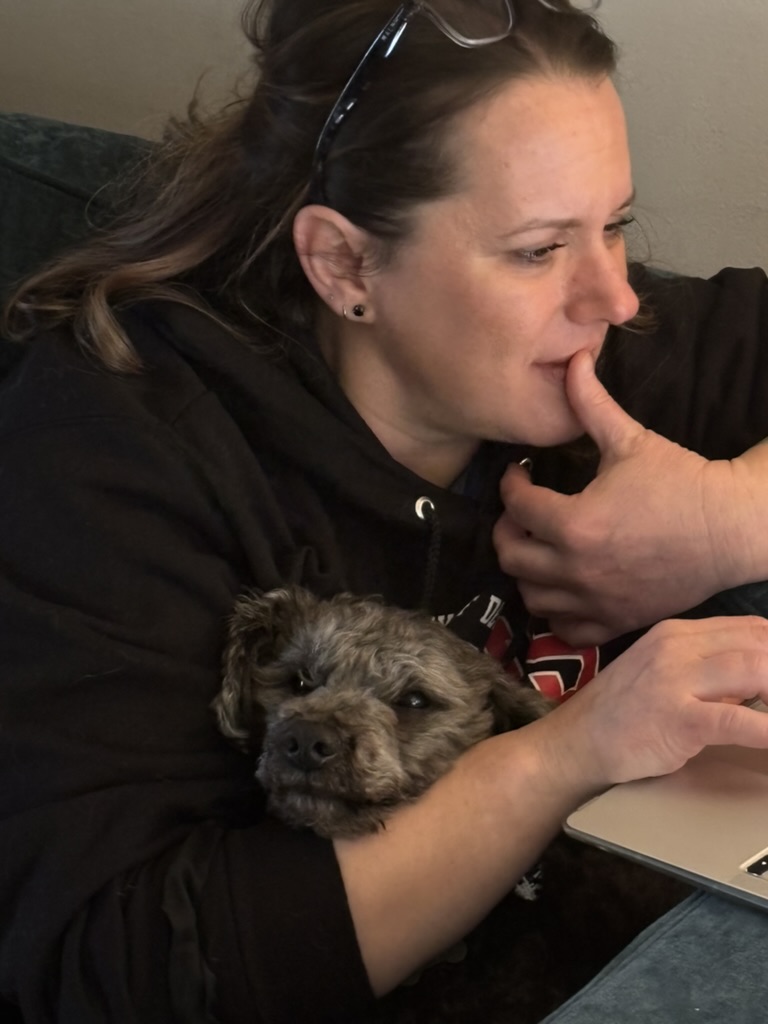
Melissa (Mel) Converse will graduate in 2026 with her BA in English (Creative Writing concentration, Literature and Museum Studies minors) and plans to pursue her MFA in Creative Writing. Besides being a full-time student, Converse is mom to two teenaged boys, three rescue dogs, and one stubbornly aged fish, and she is wife to the incredible Leanne. Converse loves all things potato based, reading poetry that makes her laugh and then writing poetry that makes her cry, and being “mom” to any of her classmates who will indulge her shenanigans. Converse has goals of publishing and teaching others to find their power in writing.
 Between the Pages
Leave a comment