by Ronan Mansilla (’26)

…and I regret to inform you that you missed out on a wonderful evening of poetry and wisdom from the brilliant and multi-faceted Srikanth (“Chicu”) Reddy. Over the course of the hour, the esteemed poet/editor/critic read from his three books of poetry and eloquently answered audience questions. Devastated that you missed it? You should be! But try not to be too hard on yourself. Although it’s no substitute for the real thing, I’ll do my best to catch you up on the first Triptych event of 2024.

After an introduction from University of Detroit Mercy’s poet-in-residence Dr. Stacy Gnall, Reddy began the reading with his latest book, Underworld Lit. Inspired by challenges in Reddy’s life, the book takes the form of a professor’s notes, containing (among other things) journal entries, snippets from the course description, and fiendishly difficult quizzes. The course in question, “Introduction to the Underworld,” is meant to “introduce students to the posthumous disciplinary regimes of various cultures” and “help them develop the communication skills that are crucial for success in today’s global marketplace.” As the narrator contends with his own mortality following a cancer diagnosis, the book becomes intriguingly dichotomous: is this a course about the underworld, or one for those who have already entered it? I highly encourage you to pick up a copy of this striking and darkly humorous book. You only live once, after all (or do you?).
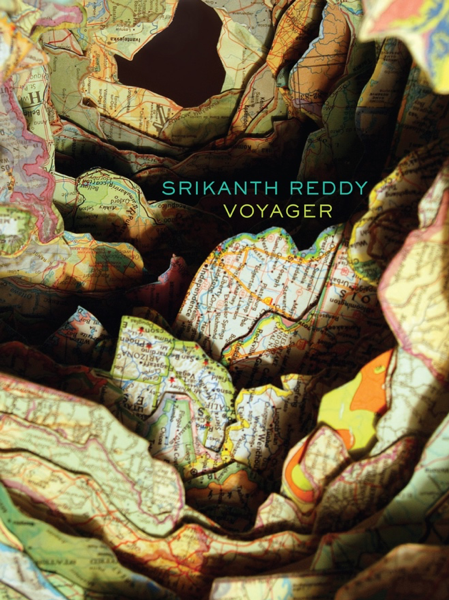
Following Underworld Lit, Reddy moved on to his second book, Voyager. At a time when Reddy felt unmoored by the political climate, he turned to his students’ poems and was inspired to produce a book of erasure poetry. Erased from what? Taking a fight-fire-with-fire approach to his political stressors, Reddy chose the memoir of the controversial Kurt Waldheim: Secretary General of the United Nations, President of Austria, ex-Wehrmacht. One of the many amazing things about Voyager is that it actually consists of three erasures, all of them of Waldheim’s memoir. Despite their shared origins, each of these erasures tells a unique story—a feat of extreme prowess on Reddy’s part. The first erasure is deeply philosophical, offering the reader propositions like: “To believe in the world, a person has to quiet thinking. / The dead do not cease in the grave.” The second is more personal, with Reddy adapting Waldheim’s words to tell his own story which includes, in true meta fashion, the writing of Voyager itself. The third erasure is a farewell to Waldheim, depicting the politician on a journey through the underworld—an appropriate follow-up if you’ve first read Underworld Lit. Voyager is a breathtaking book, a flagship example of the erasure form, and it is not to be missed.

Working Benjamin–Button-style through his poetic timeline, Reddy concluded with his first book, Facts for Visitors. This is Reddy’s most traditional book of poetry (it contains several examples of classic poetic forms), but let there be no mistake: Facts for Visitors is far from mundane, and in it, Reddy proves as adept at experimental forms as he is with classic ones. There is a myriad of interesting themes here, but the most striking of these is language itself, both as a subject (“Lately, I have taken an interest in words like ‘here.’ Here was a chapel, for instance. Here is a footprint filling with rain.”) and as something cleverly manipulated (“No matter how often you knock / on the ocean the ocean / just waves…”). Addressing the temporality of language, Reddy writes that words, once spoken, “remove themselves from expectation & are now held in memory.” He even examines ink, the historical store and vehicle of language: India ink and Earthly life are both made of carbon and water. All of this is ear candy to a word nerd like me, and I can only imagine that it would be for you, too.

The remainder of the evening consisted of a Q&A with Reddy, and through his answers, he provided valuable insight into his creative process. When asked what got him into poetry, Reddy spoke about his freshman year of high school, when one of his teachers introduced him to the challenging, philosophical poetry of Wallace Stevens. Reddy was specifically drawn to Stevens’s “Disillusionment of Ten O’ Clock,” with its descriptions of the outlandish pajamas that people are not wearing and the intriguing dreams they aren’t dreaming. It was then that Reddy realized poetry could say something different. It doesn’t have to make immediate sense, Reddy said, but “if you put time in with a poem, it can make you feel differently for all time.” Asked how he knew when a poem was completed, Reddy stated that he occasionally realizes a poem is finished only after he’s written beyond its natural conclusion. On the other hand, he mentioned that some poems are never finished but rather let go; sometimes, Reddy said, it’s the loose ends that make a poem beautiful, as they invite the reader to help make the poem’s meaning. Finally, when asked how Reddy felt about reading his older work, he said that outside of poetry readings, he rarely looks back at his prior poetry. That said, he offered this encouragement to any prospective poets: when your future self looks back on your current writing, they’ll likely miss the voice that is yours right now.

I hope this has encouraged you to pick up Reddy’s books. In the meantime, be sure to visit the University of Detroit Mercy’s English Department Linktree, where you can register for the next Triptych reading, featuring Donika Kelly. Her reading will be on Thursday, February 15th at 6:30 PM on Zoom. I look forward to seeing you there, lest you make the same grievous mistake twice by missing it. I can’t promise that I’ll be there again to help you cope with your crushing disappointment.

Ronan Mansilla is a sophomore at the University of Detroit Mercy double-majoring in English and Computer Science. When he’s not writing about himself in the third-person, he enjoys listening to New York’s most underrated band, watching surprisingly non-cheesy television, and reading about flyposting gone wrong. Also pictured is his dog, Hazel, who is not supposed to be sitting on that chair. Ronan and Hazel are both stoked about the new season of The Chosen.
 Between the Pages
Leave a comment