
On January 15th, the University of Detroit Mercy hosted its first Triptych Visiting Authors series reading of 2026 via Zoom. This reading featured Cate Marvin, poet and Professor of English at the College of Staten Island, City University of New York, who also teaches poetry writing in the Stonecoast M.F.A. Program at the University of Southern Maine. Known for her confessional intensity, lyrical fearlessness, and sharp wit, Marvin’s work resists restraint, allowing the poem itself to determine its movement. The reading was molded by the current political and cultural moment, giving the poems an added sense of urgency. As Marvin herself noted, it is “hard to let loose, especially now in our country today,” urging writers to “reconfigure your writing and be liberated with it.”
Marvin opened the evening with selections from her earlier work before transitioning into more recent poems, showing a clear evolution of her writing over time. This movement from older to newer pieces revealed a poet increasingly willing to question the body, aging, desire, and power with a matched ferocity and humor. Her poems channeled themes of personal drama and ghosts, and exhibited both genuine emotion and sharp, unexpected humor. Marvin’s work demonstrates a deep trust in language (its images, sounds, and descriptions), in letting the poem flow from language rather than be confined by it.
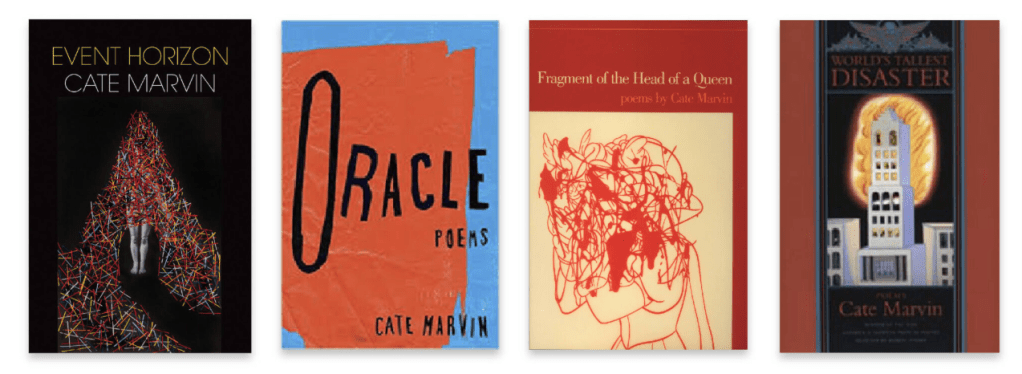
Several of the poems that were read speak of the body as a site of control, resistance, and performance. In “Botox,” Marvin approaches aging with blunt honesty and darkly comic clarity, declaring, “You can judge me all you like, a problem was solved,” before writing, “It’s altogether easier to have no expression at all.” The surreal image, “For a long time I carried my face in a sandwich baggy in my purse,” solidifies the poem’s tension between vulnerability and self-awareness. Similarly, in “An Hour,” Marvin reflects on youth, addiction, and money without restraint: “Money never felt itself being accrued of my youth,” she writes, ending with the defiant line, “Taste my money, motherfucker.” These poems reject sentimentality in favor of confrontation, forcing the listener to sit with discomfort rather than resolve it.
Imagery of nature also played a sizable role in the reading, particularly in poems centered on wisteria. In “Thoughts on Wisteria” and “Slaughter and Wisteria,” the plant becomes a symbol of persistence and distortion, something beautiful, invasive, and unruly. “The wisteria begins as a vine, becomes a tree,” Marvin writes, “though needs more years than our species has.” The image serves as a metaphor, warning, and mirror to the author’s conflicted feelings towards themes like desire and endurance. Elsewhere, Marvin’s use of repetition and circular questioning, as in “Onslaught of Circlets,” blurs boundaries between logic and lyricism, culminating in the line, “I’m a circle with no center.”

The reading concluded with a Q&A session in which Marvin spoke candidly about her writing process and her relationship to language. She emphasized that inspiration cannot be relied upon, instead pointing to language itself as the source of discovery. Writers, she explained, are “scavengers,” collecting strange phrases, unexpected titles, and sounds that lead the work forward. Marvin also addressed the vulnerability and embarrassment that can come with being a poet, noting that persistence comes not from confidence but from devotion. Teaching, she shared, helps keep her grounded and attentive, reinforcing her belief that poetry ultimately teaches her about humanity.
Cate Marvin’s Triptych reading offered more than a performance; it provided insight into a writing practice rooted in risk and attention to language. Her work emphasizes honesty and a refusal of restraint, showing how meaning can emerge when a poet allows language to lead.

Zeina Reda (’26) is a film and book nerd majoring in Political Science and minoring in Literature. She enjoys capturing moments on her cameras, collecting affection for ladybugs, and changing her Letterboxd top four almost every day.
 Between the Pages
Leave a comment