by Alyssa Knowles (’28)
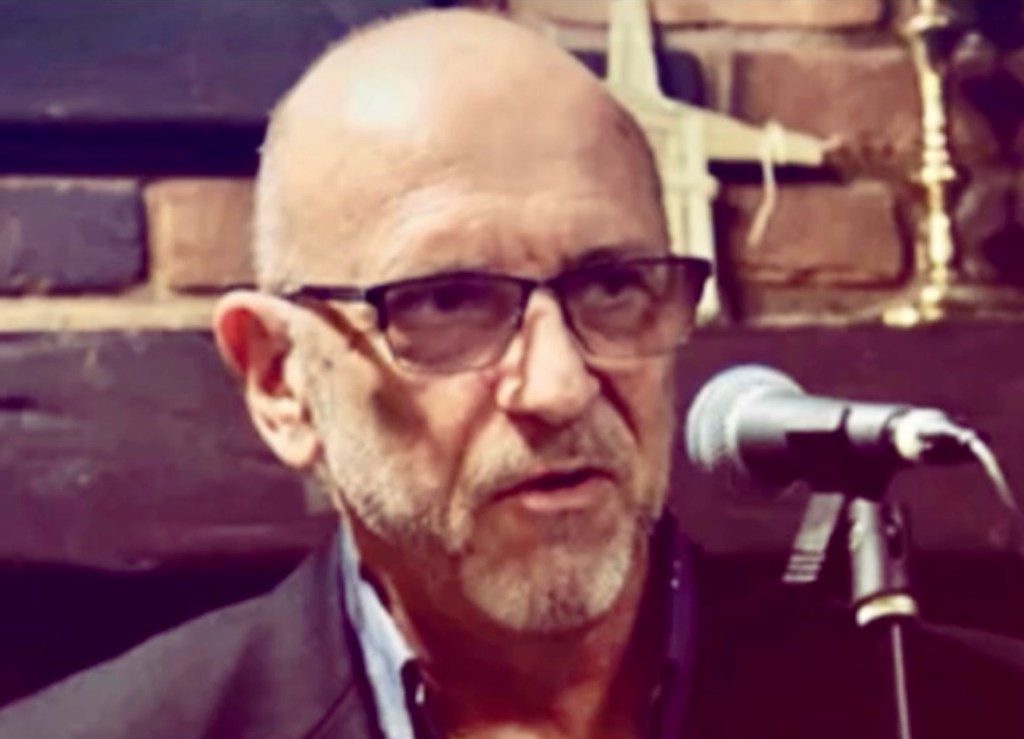
On September 15th of this year, University of Detroit Mercy’s current Poet-in-Residence, Professor Michael Lauchlan, released Running Lights, his second full-length poetry collection. To celebrate the launch of this highly-anticipated book, friends, family, and fans joined Lauchlan for a reading of his new work at 27th Letter Books in Detroit the evening of Friday, September 25th. Following the event, I was able to sit down with Prof. Lauchlan and ask him a few questions. From this interview, readers and aspiring poets alike can get a valuable, inside look into Lauchlan’s writing process, and the inspiration which led to the creation of Running Lights.
_
Alyssa: What led you down the path of becoming a writer?
Lauchlan: I think I was curious from being a very young child, and I read a lot when I was a kid. I grew up in Highland Park in a house that didn’t have a lot of books, hardly any, and I would walk to the main branch of the library, which was a distance, and I thought it was kind of a little miracle that they would just let me pick up anything I wanted to and read it. So, I was taking out books that were sort of beyond my life experience or world experience because when I was 11 or 12, you know, what did I know? Love and death and all the things that make up literature. Not very much, right? But I was curious, and I think that’s part of it. I was blessed with good teachers, and I was blessed with an ability to play music, which is what I really wanted to do. And when I discovered that I couldn’t let my emotion out through music, I redirected it to poems. I heard the music in writers like Dylan Thomas, for instance, very early on, and I said, “I wonder if I could do that.” And of course, I couldn’t do that because I’m not Dylan Thomas, but I could do something different. Many different writers just started coming in and filling up my imagination, so I think my desire to write has always been partly a musical impulse.
Alyssa: Poetry is a means of self-expression, and I feel like that’s more important than ever because of concerns over AI and how it is being used to replicate human emotion and expression. Why do you think poetry is so important in today’s world?
Lauchlan: Those are literally some of the words that I would’ve spoken. I would back up a little bit and say, you know, 10,000 years ago it was important for the same reasons. The powers of the world were creating conflicts for many people, and their word for it was “fate,” or however you say it in Greek and a thousand other languages that came to the same conclusion. So, the individual always had to wrestle with the world and that’s what lyric poetry is. And in that wrestling… In the Hebrew scripture, what we call the Old Testament, Jacob wrestling with an angel is the image that many artists have painted, and writers—Denise Levertov comes to mind—but many other writers have used that as an image. We’re wrestling with something. We’re wrestling with the mystery. We’re wrestling with how to be a human being in this moment when genocide is happening, when our neighbors are being arrested, when violence against women is taking place, and when we know about the suffering of others. But we can’t find a place to put it. A chatbot doesn’t have these problems, you know, humans have these problems, and it is a task of poetry to find a way of making sense of that wrestling on the page. And therefore, too easy of a solution leaves out the wrestling, right? We sometimes have to bring in the world quite literally, with names and places, and other times it’s more by implication that we’re really talking about slavery, the anguish of someone who was abandoned alone, and underneath it all we’re dealing with our own mortality. Another problem that chatbots do not consider, right? The human voice is being threatened in a whole bunch of ways. One very wealthy, racist… One very wealthy oligarch has just acquired all the different parts of the media empire in America. He’s going to own several news outlets and several places that make movies. That suppresses human voices who will not have those vehicles. AI is making it really difficult for young people to learn how to write a sentence and essay and to articulate their thoughts, much less write a poem. Because of that, I think the human voice is under siege and every effort, therefore, to articulate what it means to be a human being. In love, facing death, and facing injustice. Every effort shares in common that it asserts the value of the human voice.
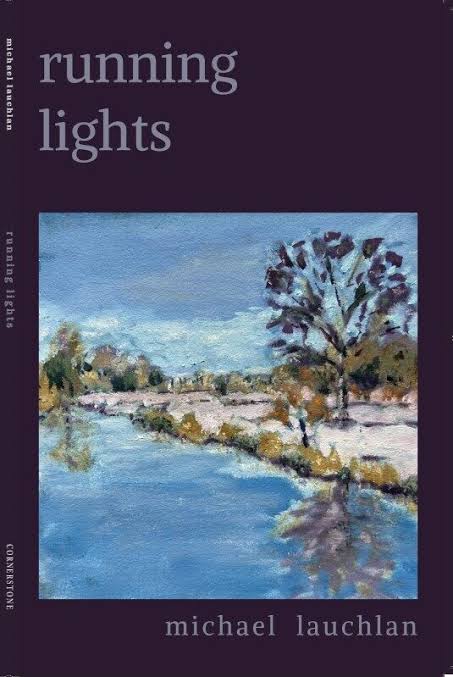
Alyssa: What inspired the creation of Running Lights? What was the catalyst?
Lauchlan: I just write what the day gives me, and then I try to assemble it into some kind of order. It’s not like I sat down and said, “Here. The title will be Running Lights. Here is poem number one.” I did not begin with that kind of scheme. Running Lights is mainly composed of poems written in the five-year period that included COVID. COVID shows up here and there, but I’m just marking it in that way. And that five-year period marked several distinct changes in my life. There was the illness of people around me and things like that, but it also marked part of the real political changes in America. Again, COVID. Global catastrophe. A variety of other things. Running Lights is also about my aging. It’s me being in my 60s and trying to figure out what it means to be this individual coming from Highland Park, and being here, and wrestling with these questions. The title poem is essentially of the delirium of driving a long distance, visiting my daughter and her family. It’s visiting my daughter and her children in Boston and then leaving, driving all night. By myself. And it’s about the way that that kind of experience is hallucinatory, but within it—assuming you don’t wreck the car—you have the opportunity to think in this kind of moving bubble of a car along an interstate. Your little world in that car. And that’s where the image of following a truck, with the lights in the back of the truck, comes up. When you can’t see very much else. And that mystery to me was evocative because I think that’s how the human being faces the cosmos. We see a couple little spots of light and a lot of darkness, and we try to keep moving. We try to make sense.
Alyssa: What do you hope readers and writers will take away from Running Lights?
Lauchlan: Compassion. I was interviewed on public radio a month ago, and one of the questions was, “Is poetry political?” and my answer was that whenever we write, we choose whether or not, and how, to expand the circle of compassion. If you write a poem that includes me, you are asking your reader to include me in their circle of compassion. Not to say that your reader will like me, or that you as the writer will approve of everything I do, but simply that you will consider me as a human within the circle of your compassion. We’re losing, in America, the willingness and even the capacity to do that. So, I hope one of the things people take away is a slightly broadened capacity for including others who don’t look just like me or sound just like me or believe what I believe.
Alyssa: Is there anything you are working on now? What is next?
Lauchlan: So, Captcha is… You know those computer things we use to prove we are human? Captcha is a continuation of that theme in the sense of… how in the face of all we are doing, and all that we are faced with, how do we establish our humanity again and again and again? And that poem wrestles with that, and interestingly about this collection, it includes some older poems. It’s a broader span of time. I included some for a variety of reasons. Somewhat accidental. Some of these poems were written before Running Lights, and some are more recent ones. So that’s one thing. And then I have a series of poems, working on various asides. Like in a drama, in a play where the character says something that is not meant for the action of the play. It’s called an aside. Shakespeare has lots of those. It might be something muttered under a character’s breath. When Laertes is about to kill Hamlet he says, “I’d almost hate to do it.” It’s an aside. And it struck me that many of the things we write are asides from our actual life. Many of the things that trouble us. I’m really interested in the things human beings think about right before we drop off and first when we wake up. Because that’s when we’re saying, “I wish I hadn’t said that. I wish I had been nicer. I wonder what he thinks of me after what I did?” That’s when we’re kind of looking, we’re kind of peeling back the surface of the self—the persona, if you will—and looking inside. Those are asides, you know? Most of that stuff is never even going to get said out loud to anybody.
Alyssa: What words of advice or encouragement do you have for aspiring writers?
Lauchlan: Read, read deeply. Read everything, but then go into the stuff you really like. Read it all, and then go back to the stuff that sets you on fire and keep reading it. Be curious. Keep your eyes open in the world. By the way, you have to treat your curiosity like a house plant. You gotta feed it a little water. You have to make it. It’s not going to just do it by itself. I say this in guilt because I’m in the midst of killing one really nice-looking plant I have neglected. But read, be curious, and keep your eyes open. And… Be driven by compassion.
_
Michael Lauchlan is also the author of Trumbull Ave. (2015). He has contributed to many publications, including New England Review, Virginia Quarterly Review, North American Review, and Valparaiso Review. He lives and teaches in the Detroit area.
Running Lights is available now on Bookshop.org.
_
About the Author: Alyssa Knowles is a 3rd year student studying English and Computer Science. She enjoys writing, programming, and music. When she is not engrossed in her studies, she takes pleasure in nature walks and trying new food spots around her city.


Leave a Reply